Abstract
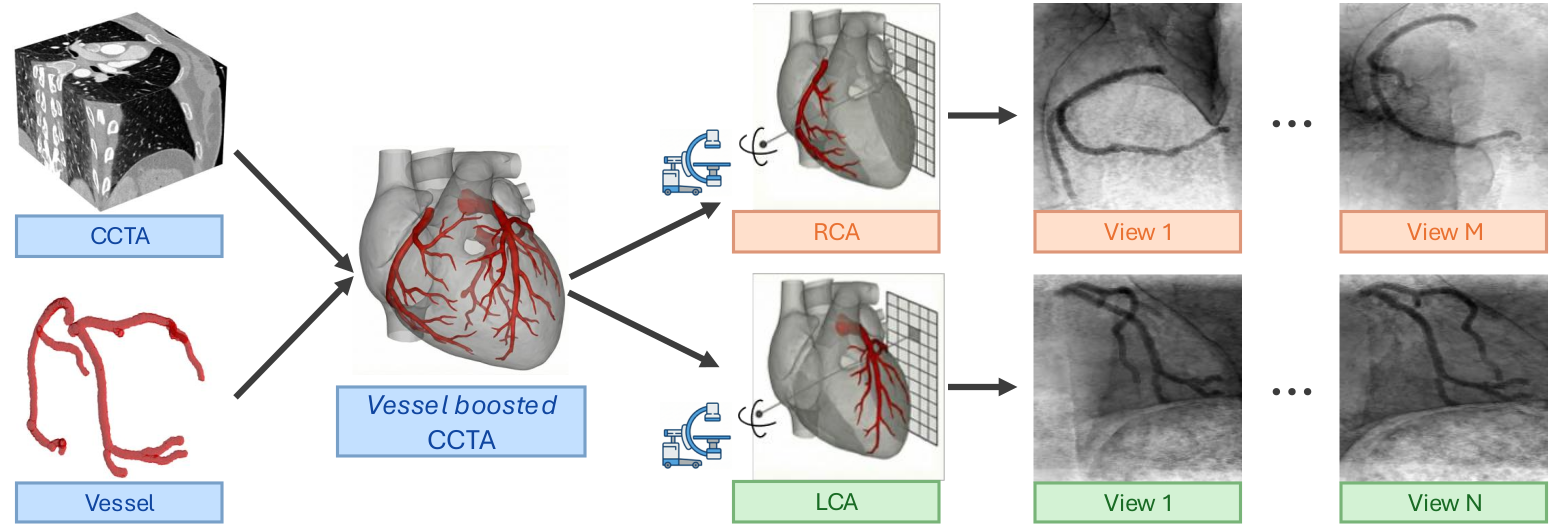
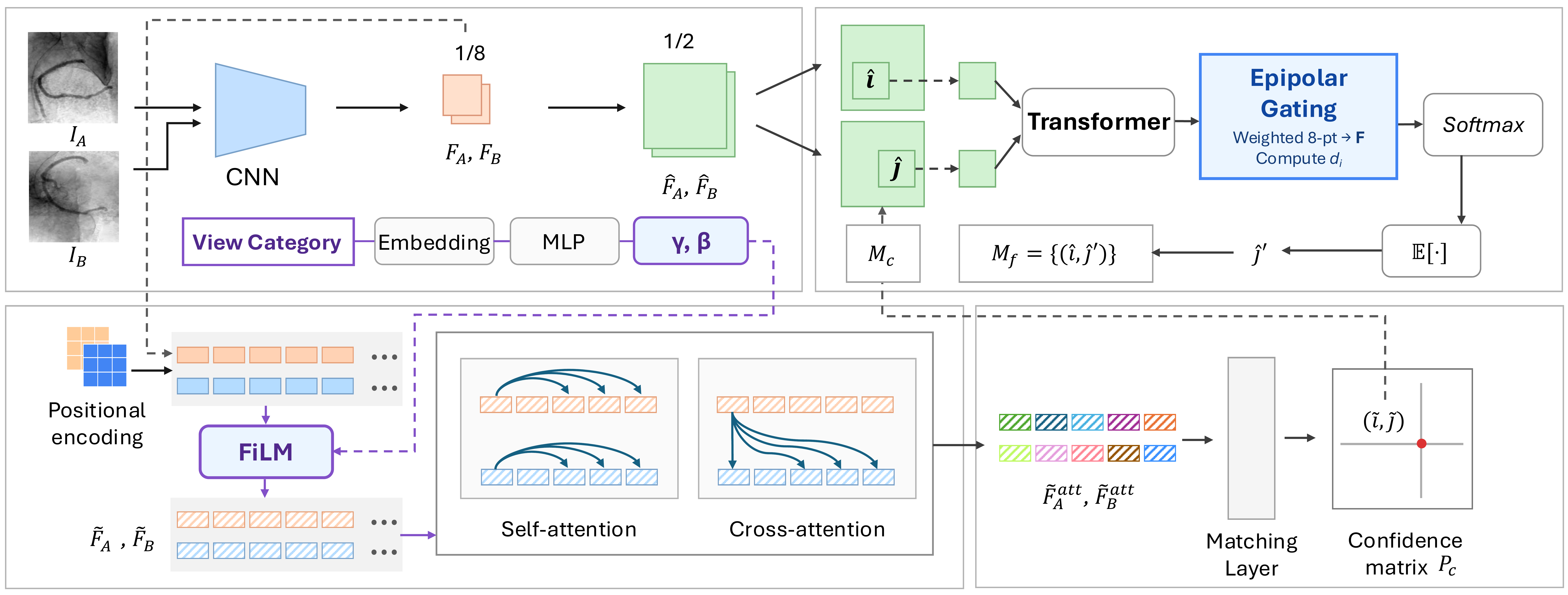
Reliable multi-view correspondence in coronary angiography is hard to supervise: real X-ray angiograms have no dense ground-truth matches. We generate anatomy-grounded synthetic angiograms from coronary CT angiography (CCTA) volumes and their vessel masks using a physically grounded DRR (digitally reconstructed radiograph) pipeline. Because every frame is projected from known 3D geometry, each image pair comes with dense 3D-to-2D correspondence labels at no manual-annotation cost. We simulate routine clinical C-arm views for the right and left coronary trees, yielding 26,205 multi-view image pairs split by patient. On this data we train GIMM, a Geometry-Informed Matching Module that adds two priors to a coarse-to-fine matcher: view-class conditioning via FiLM and epipolar gating at the fine stage.
Method
Data
Physically grounded DRR pipeline
- CCTA volumes and coronary masks projected under simulated C-arm geometry.
- Projecting the 3D centerlines gives exact 2D correspondences and 3D positions for every match.
- Dense supervision with no manual annotation.
- 26,205 multi-view pairs across the RCA and LCA trees, split by patient.
Model
GIMM: geometry-informed matching
- Coarse-to-fine (LoFTR / QuadTree) matching backbone.
- FiLM conditioning on the clinical view class.
- Fine-stage epipolar gating that suppresses geometrically implausible matches.
Results
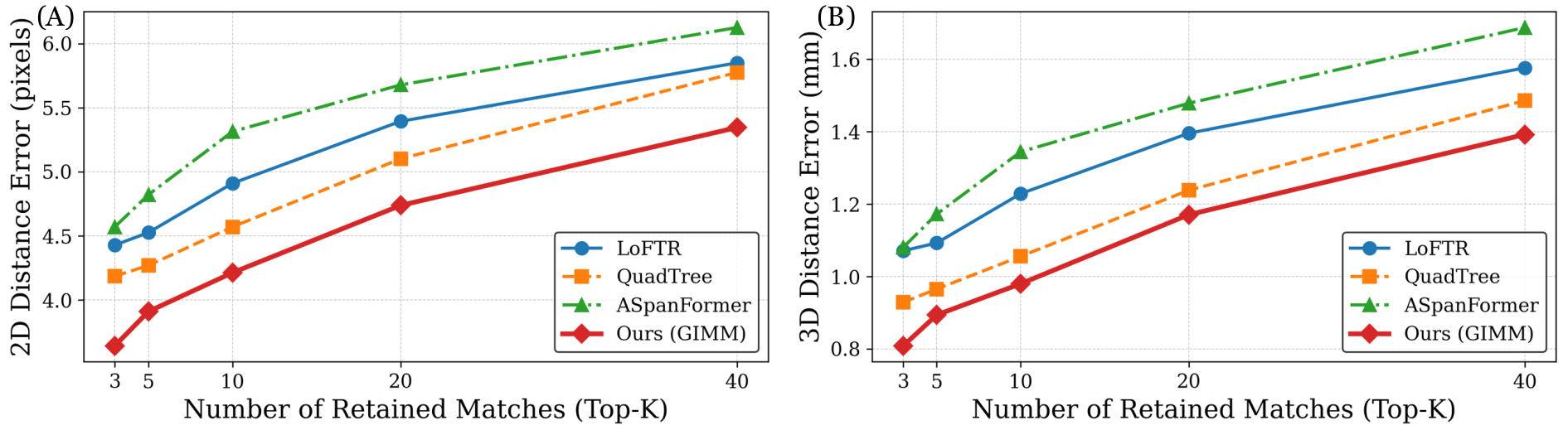
Because the synthetic data carries dense known geometry, correspondence error is measured directly in 2D pixels and 3D millimeters. GIMM achieves the lowest error across every top-K budget, ahead of LoFTR, QuadTree, and ASpanFormer.
Compared against correspondence baselines on the synthetic DRR test set (top-K = 20) and on real coronary angiography, GIMM leads on 2D / 3D accuracy and on real-data landmark F1:
| Method | Synthetic (2D) | Synthetic (3D) | Real | |||
|---|---|---|---|---|---|---|
| Dist. (px) ↓ | Prec@3px ↑ | Prec@5px ↑ | Dist. (mm) ↓ | F1@5px ↑ | F1@10px ↑ | |
| SuperGlue | 7.249 | 0.425 | 0.691 | 4.251 | 0.151 | 0.273 |
| ASpanFormer | 5.678 | 0.515 | 0.878 | 1.478 | 0.149 | 0.272 |
| LoFTR | 5.394 | 0.505 | 0.772 | 1.395 | 0.170 | 0.300 |
| QuadTree | 5.102 | 0.536 | 0.795 | 1.238 | 0.168 | 0.308 |
| Ours (GIMM) | 4.738 | 0.547 | 0.813 | 1.171 | 0.175 | 0.332 |
BibTeX
@inproceedings{gimm_miccai2026,
  title     = {Anatomy-Grounded Synthetic Coronary Angiography for
               Geometry-Informed Multi-View Matching},
  author    = {Lee, In Kyu and Seo, Sumin and Min, Jaesik},
  booktitle = {Medical Image Computing and Computer Assisted
               Intervention (MICCAI)},
  year      = {2026}
}